
The Necessity of Chalcedon
The human union lets God die for us, unlike His brief Old Testament appearances.
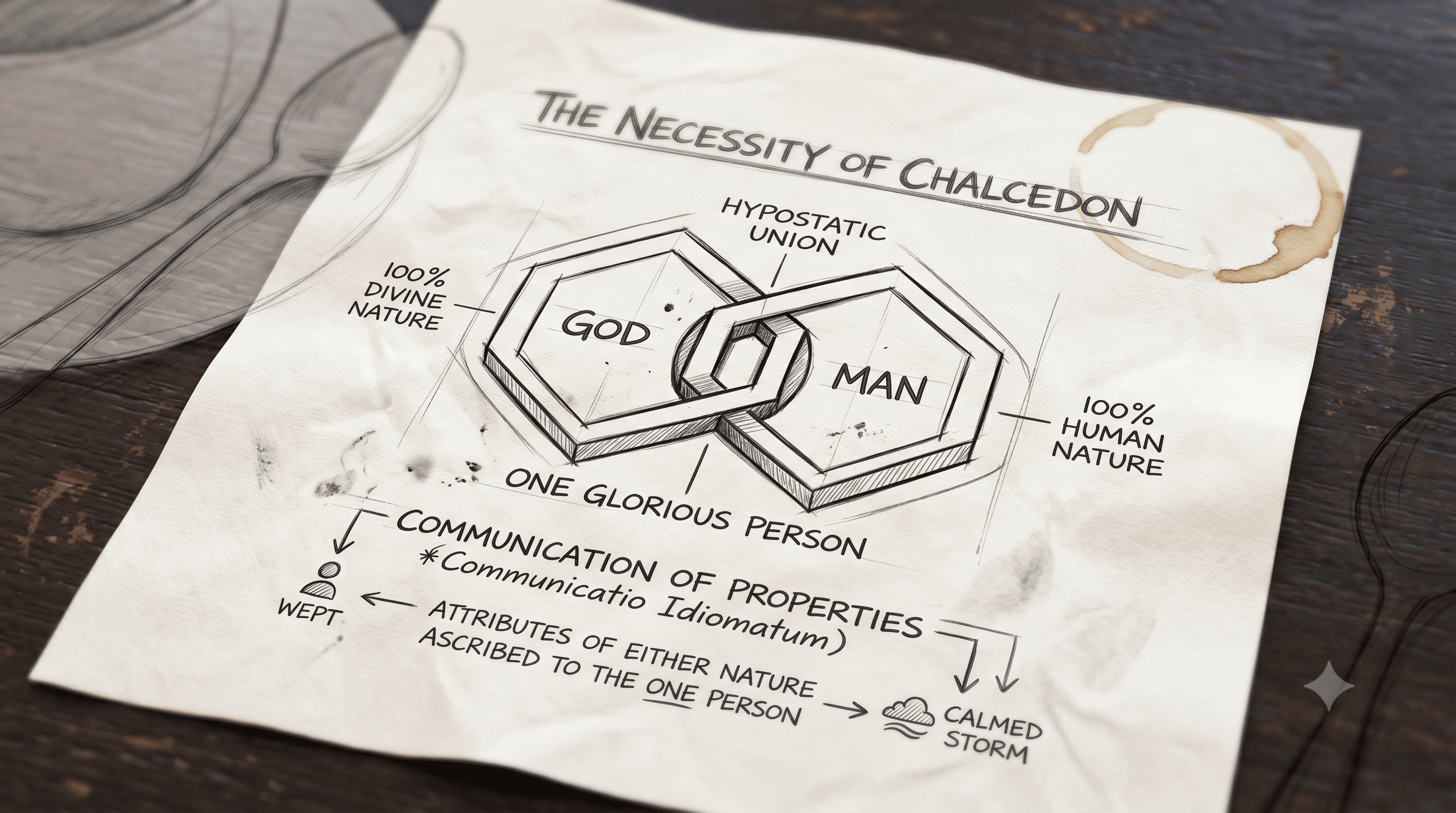
In my last article, we established the great biblical and historical bulwark of our faith: the Definition of Chalcedon. We affirmed that our Lord Jesus Christ is one glorious Person who possesses two full and distinct natures—He is 100% God and 100% man.
We saw that this Hypostatic Union (the uniting of the two natures in the one person of the Son) is what makes sense of the Communication of Properties (Communicatio Idiomatum). This is the biblical pattern of speaking where the properties of either nature (human or divine) are attributed to the person of Christ.
I want to build on that foundation. My goal is to show you that nothing less than the Hypostatic Union is sufficient for this Communication of Properties.
This isn't just a theological puzzle. This distinction is vital for rightly understanding who Christ is and who He is not. It is the very key that unlocks the profound difference between the incarnation of Christ and His appearances in the Old Testament.
The Union is the Engine of the Communication
Think of it this way: the Communicatio Idiomatum is the "speech pattern" we are allowed to use because the Hypostatic Union is the reality.
The Communicatio Idiomatum is not a mixing or blending of the natures themselves. The divine nature never became human, and the human nature never became divine. Rather, the Person of the Son is the single subject who acts and experiences through whichever nature is appropriate to the action.
- When Jesus walked on water, the Person of the Son did so through His divine power.
- When Jesus wept at Lazarus's tomb, the Person of the Son did so through His human emotion.
- When Jesus died on the cross, the Person of the Son did so through His human nature.
The Person is the "I" who says "I thirst" and also "I and the Father are one."
The only reason we can say, "God the Son died" (as in Acts 20:28) is because the Person of the Son permanently and personally took to Himself a human nature that was capable of dying. He owns that human nature. It is His. Therefore, its death was His death.
The Hypostatic Union is the bedrock. Without it, the Communication of Properties is impossible and nonsensical. If Christ were two separate persons (Nestorianism), you could never say "God died"—you could only say the "human person" died. The gospel would be lost.
The Test Case: The Angel of the LORD
This brings us to a glorious and mysterious part of the Old Testament: the "Angel of the LORD."
We often encounter a figure in the Old Testament who is called "the Angel of the LORD" (Genesis 16, Exodus 3, Judges 6) yet speaks as God, receives worship as God, and bears the very name of God. As Reformed Baptists, we rightly understand this to be a "Christophany"—a pre-incarnate appearance of the Son of God.
But here is the crucial question: When the Son of God appeared as an angel, did He become an angel?
The answer from Scripture is an emphatic No.
The Son of God appeared in the form or guise of an angel, just as He appeared to Moses in the form of a burning bush or to Abraham in the form of a man (Genesis 18). These were temporary manifestations, or "theophanies."
The Incarnation, however, was something entirely different and infinitely more profound. The Son of God did not just appear as a man; He became man.
Our own Confession (8.2) is precise about what nature He did take, stating He "take upon him man's nature, with all the essential properties and common infirmities thereof, yet without sin."
The reason for this specificity is made plain by the author of Hebrews, who draws the sharp contrast that our theological forefathers believed, even if they didn't include this specific quote in 8.2. Hebrews 2:16 says, "For surely it is not angels that he helps, but he helps the seed of Abraham." Therefore, as the text clearly implies, he took not on him the nature of angels; but he took on him the seed of Abraham.
Why There Is No "Angelic" Communication of Properties
Now we can see the vital distinction.
The Son of God did not enter into a Hypostatic Union with an angelic nature. He never "became" an angel. He never personally possessed a complete angelic nature in the same way He possesses His human nature.
Therefore, the Communicatio Idiomatum cannot apply.
Because there is no Hypostatic Union with an angelic nature:
- We can never say, "God the Son is a created spirit-being."
- We can never say, “God the Son has passions before the Incarnation.”
- We can never attribute any properties of an angelic nature to the person of the Son.
To do so would be a grievous error. He merely used the form of an angel as a temporary vessel for His appearance. He did not unite that form to His person.
We can, however, say:
- "God the Son was born."
- "God the Son was tempted."
- "God the Son shed His blood."
Why? Because He did enter into a Hypostatic Union with a human nature. He became man.
The Glory of Our High Priest
Do you see the glory in this? This isn't just "splitting hairs." This distinction makes the Incarnation the most unique and glorious event in history.
The Son of God did not become an angel to save angels. He became a man to save men.
He did not just visit our world in a temporary disguise. He bound Himself to our humanity forever. He became our kinsman, our brother, our representative. When He died, it was a real death in a real human nature, offered by a divine Person, and it is that and nothing less that saves us.
Any "Christology" less than Chalcedon fails. Any "union" less than the Hypostatic Union is insufficient. Only because our Lord is the true God-Man can He be the one mediator, our perfect High Priest, able to save to the uttermost those who draw near to God through Him.
Praise God for His indescribable gift!