
Confessional Christology
An explanation of biblical Christology, defining Jesus as 100% God and 100% man.
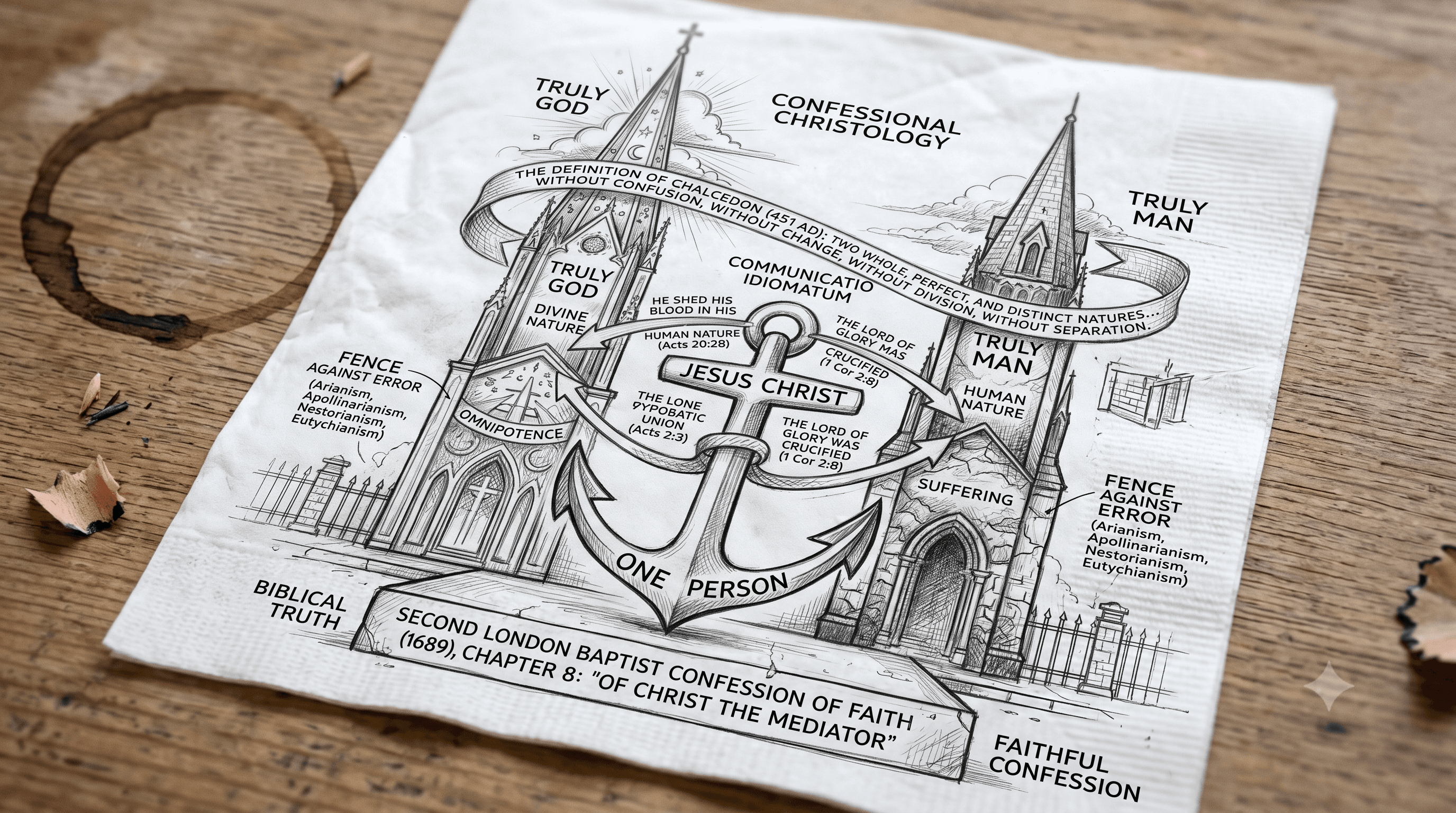
From time to time, it is good for us to pause and reflect not just on what we believe, but why we believe it, especially regarding the great, central mystery of our faith: the person of our Lord Jesus Christ.
We confess these truths when we affirm our Second London Baptist Confession of Faith. Chapter 8, "Of Christ the Mediator," is one of the most glorious summaries of biblical teaching ever penned. But this chapter was not written in a vacuum. It stands on the shoulders of faithful believers who, for centuries, fought to protect the biblical gospel from devastating errors.
My goal in this article is to explain, in simple terms, the classical, biblical, and confessional Christology that we believe. I want to equip you to understand why our confession says what it says about Jesus, focusing on three key ideas: the Definition of Chalcedon, the Hypostatic Union, and the Communicatio Idiomatum.
1. The Problem: Why Was a Definition Needed?
The early church wholeheartedly believed what the apostles taught: Jesus is God (John 1:1; Col. 2:9) and Jesus is man (1 Tim. 2:5; Heb. 2:14).
But as the church grew, false teachers arose who tried to "solve" the mystery of how this could be.
- Some, like the Arians, denied Jesus was fully God. They said He was a created being, like an angel.
- Others, like the Apollinarians, denied He was fully man. They said He had a divine mind but a human body (not a true human soul).
- Later, Nestorius seemed to teach that Jesus was two separate persons—a divine person and a human person—sharing a body. This would destroy the unity of Christ.
- In reaction, Eutyches taught that Christ's humanity was "swallowed up" by His divinity, creating a new, blended, "third thing" that was neither fully God nor fully man.
The church saw that all these errors destroyed the gospel. If Jesus is not fully God, His sacrifice is not sufficient to save. If He is not fully man, He cannot be our substitute or represent us.
2. The Solution: The Definition of Chalcedon (451 AD)
To guard the biblical truth, church leaders met at the Council of Chalcedon. They did not invent a new doctrine. Rather, they built a "fence" around the biblical teaching to protect it from all these errors.
Their definition, which is the foundation of our own confession, can be summarized like this:
We confess one and the same Son, our Lord Jesus Christ... truly God and truly man...
...acknowledged in TWO NATURES which are united IN ONE PERSON.
The natures are united:
- Without confusion (against Eutyches: they don't blend into a third nature)
- Without change (divinity doesn't become humanity; humanity doesn't become divinity)
- Without division (against Nestorius: you can't "divide" Jesus into two people)
- Without separation (they are united forever)
This is what our 1689 Confession means when it says (8.2): "...two whole, perfect, and distinct natures... were inseparably joined together in one person, without conversion, composition, or confusion."
This brings us to the two great concepts that flow from Chalcedon.
3. Key Concept: The Hypostatic Union
This is a fancy term for a simple, profound truth. The word hypostasis is the Greek word for "person."
- Hypostatic Union: This simply means that in the one person of Jesus Christ, two complete natures (one fully divine, one fully human) are united.
Think of it this way: Jesus is not 50% God and 50% man. He is 100% God and 100% man at the same time.
Before the incarnation, the Son of God existed from all eternity as the second person of the Trinity. At the appointed time, this divine person took to Himself a human nature (a human body and soul) through the virgin Mary.
He did not stop being God, nor did He "add" a new person. The one, eternal person of the Son now possesses and lives through two distinct natures. This is the mystery of John 1:14: "And the Word [who was God] became flesh and dwelt among us."
4. Key Concept: The Communicatio Idiomatum
This Latin phrase is the most complex, but it's a beautiful truth that unlocks many parts of Scripture.
- Communicatio = Communication or sharing.
- Idiomatum = Properties or attributes.
It means the "communication of properties."
Here is the definition: Because Jesus is one undivided person, whatever is true of either of His natures (human or divine) can be said about His person.
Here is what it does NOT mean: It does not mean the natures themselves mix. The divine nature cannot suffer, die, or be "born." The human nature is not all-knowing or all-powerful. The natures remain distinct.
But the person of Christ experiences these things through His natures.
This rule of "communicating properties" helps us make sense of difficult Bible verses.
- Acts 20:28: Paul tells the Ephesian elders to "care for the church of God, which he obtained with his own blood."
- Question: How can God (who is spirit) have blood?
- Answer: The person who purchased the church is God the Son. He shed His blood in His human nature. Because He is one person, we can say "God" shed His blood.
- 1 Corinthians 2:8: Paul says the rulers of the age "crucified the Lord of glory."
- Question: How can the "Lord of glory" (a title for God) be crucified?
- Answer: The divine nature cannot suffer. But the person who is the Lord of glory suffered and was crucified in His human nature.
- John 3:13: Jesus says He is the "Son of Man who is in heaven."
- Question: How can Jesus be talking to Nicodemus on earth and be in heaven at the same time?
- Answer: The person of the Son of Man is on earth in His human nature. But that same person is omnipresent (everywhere, including heaven) in His divine nature.
This rule protects us. We don't have to "split" Jesus into two (Nestorianism) or "blend" Him into one (Eutychianism). We can simply worship the one glorious person who is our mediator.
Why This Matters for Our Souls
This is not just abstract theology. Your salvation depends on it.
- He must be truly MAN: He had to be one of us to be our representative. He had to have a real body to be "obedient to death, even death on a cross" (Phil. 2:8) and shed real blood for our sins. He had to be a human high priest to "sympathize with our weaknesses" (Heb. 4:15).
- He must be truly GOD: His human sacrifice would have been worthless to save anyone else unless He was also God. Only as God could His sacrifice have infinite value to satisfy God's wrath.
We worship one Christ. He is the God-Man, our perfect mediator. He is human enough to die for us and God enough to save us.
This is the glorious truth we confess. This is the Jesus we love and serve. May we stand firm in this faith, "contending for the faith that was once for all delivered to the saints" (Jude 3).